
You are here

Solar and Planetary Systems
Image_page_presentation_30mai2025.png


The team conducts research on three themes:

    (1) Solid planets and satellites of the solar system

    (2) Asteroids and comets

    (3) Exoplanets


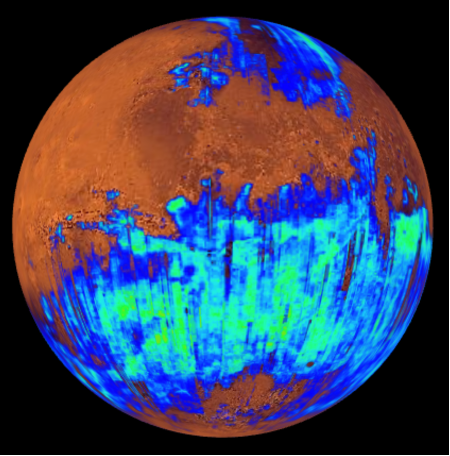
Using instruments aboard space missions, the team measures the composition of planetary surfaces and atmospheres.


The aim is to characterize the processes of physicochemical and climatic evolution in order to trace the history of the planets.


Particular attention is paid to water and carbon: where and in what state are they found in the Solar System today? What is their history, from primordial inputs to contemporary processes? What is Earth's place in the diversity of planets and exoplanets?


The team's recent research has focused in particular on Mars, water- and carbon-rich asteroids, the icy moons of Jupiter, Mercury and the atmospheres of exoplanets. The composition of these objects is studied using spectrometers and visible and infrared imagers.


Our approach combines observation, data analysis, numerical modeling and laboratory simulation. One of the team's distinguishing features is its direct involvement in the construction of numerous space instruments, with a constant concern to combine scientific and technological challenges. The team also works on microscopic analysis analysis of extraterrestrial samples, in close collaboration with the astrochemistry team.

 

Subscribe to Syndicate

Dernières news

2 years 1 month ago

How many earth-like planets orbit the habitable zone of solar-like stars? How planets form and evolve in their planetary systems? What about the interaction with their stars? These are among the questions the ESA PLATO mission is called to answer, through exquisite measurements of exoPLAnet Transits and Oscillations of stars (you now know the origin of the PLATO acronym). The “transit” measurements yield information on the size of the planets, while the “stellar oscillations” give us the mass and age of the stars, which in turn are fundamental to assess the mass and age of the hosted planets. The exquisite quality of all such measurements is secured by 26 ultra large field-of-view cameras that make the eyes of the PLATO mission.

2 years 4 months ago

During 2023, IAS was able to test 3 Flight cameras (PFM, FM4, FM5) at the Calibration Station. The last camera was finished testing in the second week of December. All of the tests of these cameras took a little over 6 months, during which thermal vacuum tests were carried out as well as scientific performance tests. A team of about twenty people from IAS and the Station worked to enable these tests. Congratulations to all for this major achievement!

2 years 10 months ago

Friday June 2nd was the 20th anniversary of the launch of the first ESA probe towards another planet, Mars. A celebration was held at the ESA control center (ESOC) in Darmstadt, Germany. Several colleagues from IAS were there representing the laboratory and the OMEGA team.

2 years 12 months ago

The launch of the JUICE mission was carried out perfectly thanks to the penultimate Ariane 5, Friday April 14, 2023 at 2:14 p.m. Paris time. The first crucial hours of the mission, which included the first communication signals with the spacecraft, first TC and deployment of the solar panels took place nominally. Direction Jupiter and its icy moons!

Pages